Rock-Eating Fungi with Quinn Moon
Monday, September 14, 7:30pm
Zoom link will go to members via email.
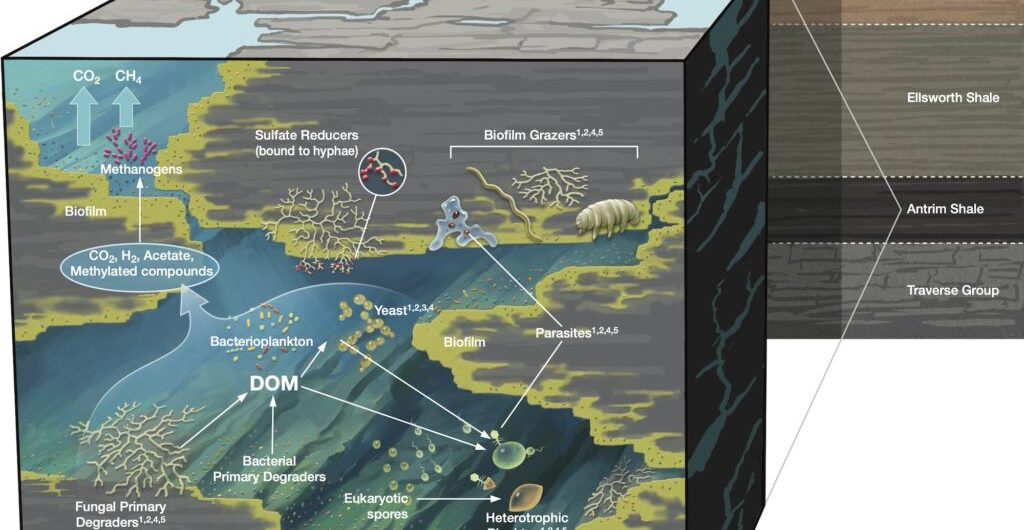
Once considered largely devoid of life, Earth’s deep subsurface is now recognized as an extensive biome containing a substantial fraction of the planet’s microbial cells and most of its organic carbon. Quinn’s research investigates how fungi drive and sustain energy flow and elemental cycling in the subsurface. Their results demonstrate that fungi in deep, organic-rich shale are not only present and phylogenetically diverse but can also contribute substantially to microbial biomass, implicating them as active participants in subsurface carbon cycling.
Quinn Moon is a fourth year PhD candidate in Tim James’s Mycology Laboratory in the Department of Ecology and Evolutionary Biology at the University of Michigan. Previously, they worked in both Dr. Anthony Amend and Dr. Nhu Nguyen’s fungal ecology labs at the University of Hawai‘i. They are broadly interested in fungal biodiversity with particular interest in how such taxonomic diversity of fungi drives ecosystem functioning and nutrient cycling. Their dissertation research is centered on Deep Earth inhabiting fungi and aims to determine the drivers of fungal community composition across subterranean terrestrial biospheres and link these patterns to long term microbial conversion of organic carbon deposits. This work informs not only the global estimate of fungal diversity but also explores the fate and release of organic carbon in Earth’s crust.
You can also check out the original paper, as well as U of M’s press release.